

Awaab’s Law moves closer to private landlords. Is Wales next?
An update from of Director of Operations, Nik Lewis. With winter around the corner, now’s a good time to brush up on how you handle damp and mould reports. With legislation around these issues also evolving, our free landlord guide covers what to look out for, how to respond and the steps you should be taking when concerns are raised. Take a look!
Last week (9th October), the UK Government launched a consultation on extending Awaab’s Law to England’s private rented sector. It’s asking landlords, tenants and housing professionals how the law should work, what timescales should apply and when the new requirements should come into force.
For Welsh landlords, there’s no immediate change, but this latest development is another reason to pay close attention to a piece of legislation that could have a significant impact on how we manage rented properties in the years ahead.
I’ve written about Awaab’s Law several times over the last couple of years, including the circumstances that led to its creation, so I won't revisit all of that here. Instead, I want to focus on what's changed, where Wales currently stands and – perhaps most importantly – what private landlords should be doing now.
England is preparing to bring private landlords into the fold
Awaab’s Law came into force in England's social rented sector in October 2025, introducing legally enforceable deadlines for investigating and addressing certain serious hazards.
As I explained at the time, the requirements initially focused on significant damp and mould hazards and emergency hazards, with additional types of hazard being brought into scope in stages.
Through the Renters’ Rights Act 2025, the UK Government has already committed to extending Awaab's Law to England's private rented sector. The question now is exactly how that will work.
The consultation, which closes on 18th December 2026, considers everything from the severity of hazards that should trigger the law to inspection requirements, repair deadlines, written reports and the provision of alternative accommodation.
It also asks how landlords should be treated when a problem results from a tenant's breach of contract, or when the necessary repairs are the responsibility of a freeholder rather than the landlord letting the property.
These are important considerations. A private landlord with one or two properties and a network of independent contractors operates very differently from a housing association with an in-house maintenance department. Both should be expected to provide safe homes, but the practical arrangements for achieving that may not always be identical.
The Government says 2027 is the earliest feasible implementation date in England, although it's also seeking views on 2028 and 2029.
Wales has already made its own move
On 1st April 2026, Welsh Government introduced new requirements for social landlords through an amendment to the Welsh Housing Quality Standard (WHQS).
Under these rules, certain housing hazards posing a significant risk, where the cause is within the landlord's control, must be investigated and remedied within fixed timeframes.
For hazards involving an assessed likelihood of imminent harm, social landlords have 24 hours to investigate and a further 24 hours to remedy the hazard, with action to make the property safe expected as soon as possible.
For other qualifying significant hazards, the deadlines are 10 working days to investigate and a further five working days to remedy. Where a landlord cannot meet the deadline despite their best endeavours, a written action plan must be provided.
Although this isn't the same legislation as England's Awaab's Law, the similarities are obvious.
Importantly, these new WHQS deadlines apply to Wales' social rented sector, not its private rented sector.
So, where does that leave private landlords here?
Equivalent requirements in Wales are increasingly likely
Welsh private landlords are already subject to legislation requiring their properties to be fit for human habitation.
The Renting Homes (Wales) Act 2016 and the associated Fitness for Human Habitation regulations place clear obligations on landlords, including in relation to damp and mould. The Housing Health and Safety Rating System (HHSRS) also remains applicable. We explored these existing obligations in our earlier article, Awaab's Law vs. existing damp and mould legislation.
What we don't currently have in the Welsh private rented sector is an equivalent set of fixed statutory investigation and repair deadlines under Awaab's Law.
I find it difficult to imagine Welsh Government being content with private tenants in Wales having less clearly defined protection around response times than those in England.
And with Wales having already introduced similar requirements for social housing, and England now taking steps towards its private rented sector, I think it's sensible to prepare for the possibility of further change.
What would landlords actually need to do differently?
In many ways, the underlying responsibility won't change. Landlords already need to provide safe, fit homes and respond appropriately to problems.
What I believe will change is the importance of being able to demonstrate exactly what was done, when it was done and why. After all, if a tenant is aware of a piece of legislation that says their landlord is required to inspect a damp/mould report within X days – and with the ever-growing use of AI, you can bet your bottom dollar they will be aware of it – they will point to that in their compensation request if they feel the timescale wasn’t adhered to.
Take a fairly typical situation: a tenant reports mould appearing around a bathroom window. It's tempting to conclude that it's condensation, perhaps caused by insufficient heating or ventilation. Sometimes that assessment will turn out to be correct.
But it's not something a landlord should simply assume without properly considering the evidence. Is the extractor fan working? Is the window openable, with trickle vent functioning? Is the heating adequate for the room? Are the tenants using of all these combative tools?
Those are the sorts of questions that need to be considered, investigated where appropriate and documented.
The landlord also needs to consider the severity of the hazard and the circumstances of the people living there. Something relatively manageable for one occupant could pose a much greater risk to somebody with a respiratory condition, for example.
Then there's the paper trail. When was the issue first reported? How quickly was it acknowledged? What did the inspection reveal? What advice was given? When was a contractor instructed? What work was completed? Was the tenant kept informed, and was the outcome checked?
If a disagreement subsequently arises, simply saying that you dealt with the matter promptly may not be particularly persuasive. Being able to demonstrate it with dated records, photographs, correspondence, professional advice and contractor documentation is a very different proposition.
This is something I explored in more detail in Awaab's Law: The practical implications for landlords.
How we're already addressing this at CPS Homes
None of this is entirely new territory for us. We've long recognised the importance of having clear processes for dealing with damp and mould reports, rather than leaving individual members of staff to decide how each case should be handled.
When reports come in, our systems are designed to ensure they're acknowledged and recorded, the circumstances are assessed, appropriate inspections take place, and the findings and subsequent actions are documented. That includes photographic evidence, checks of the property's heating and ventilation, written advice to occupants, records of contractor instructions and follow-up where necessary.
We're also conscious that prevention is preferable to dealing with a problem once it's become serious. That's why we place importance on educating occupants about condensation, ensuring the necessary heating and ventilation facilities are available and identifying potential issues during property inspections. We send out detailed advice on preventing condensation and mould in the home to all tenants.
Our processes will naturally need reviewing and adapting if new statutory requirements are introduced, but the foundations are already there.
And for landlords who manage their properties themselves, there's no need to wait for another piece of legislation before putting similar systems in place.
A free guide for landlords
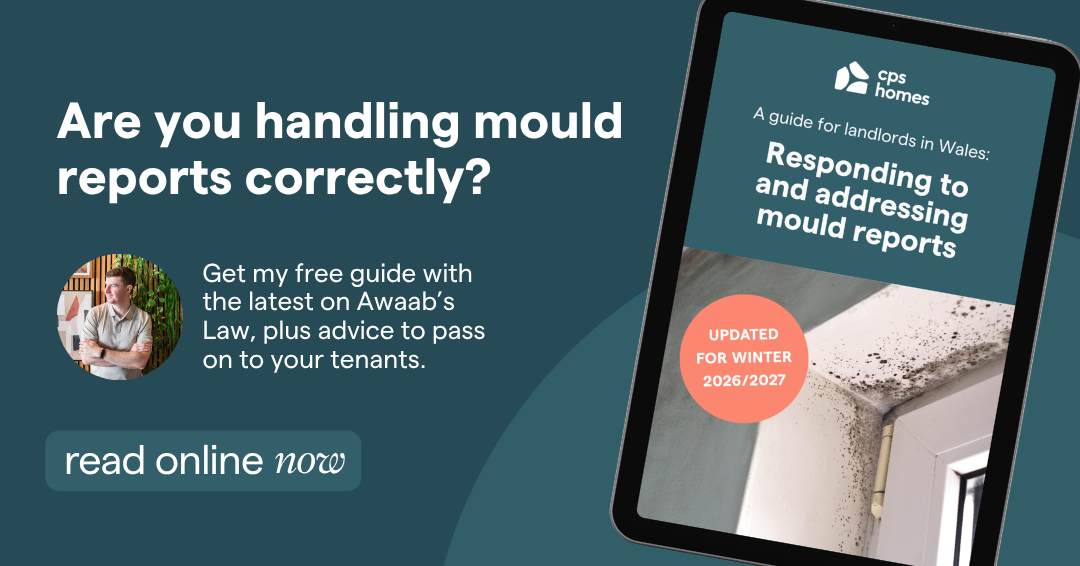
We've produced a practical, 15-page Landlord's Guide to Responding to and Addressing Mould Reports, updated for winter 2026/2027.
It covers the common causes of condensation and mould, prevention, the importance of inspections and record-keeping, and the practical steps landlords can take to protect their position.
It also includes guidance you can share directly with your tenants to help them understand how to minimise condensation and report problems early.
Download our free landlord's guide here.
My advice? Don't wait for a deadline
Wales will almost certainly soon introduce equivalent Awaab's Law requirements for private landlords. We don’t know precisely what they might look like, but I don't think waiting for legislation is the sensible approach.
If you're a landlord, my advice is to make sure reports are taken seriously, your properties are properly inspected, your communication is documented and your contractors' work is followed through.
Good records don't just help protect you in the event of a dispute. They help you manage your properties better and provide a safer home for the people living in them.
At CPS Homes, we'll continue following developments in both England and Wales, reviewing our procedures and keeping our landlords informed, so they're not left trying to catch up when the rules change.
After all, good property management shouldn't begin when a new law tells you what to do.
The information contained within this article was correct at the date of publishing and is not guaranteed to remain correct in the present day.