EPC changes explained: What do the new ratings mean for landlords?
Expert insight from Nik Lewis, Director of Operations at CPS Homes. Nik keeps a close eye on the changes affecting landlords across Cardiff and Wales - for more regular updates, advice and opinion, follow @thecardifflettingagent on Instagram.
EPCs are changing from one overall rating, to several. But what does each one of these new metrics actually mean? Let’s take a look…
What will happen to your current EPC?
First, a quick recap. If a property has an EPC lodged before October 2029 showing a ‘C’ or above on the current single overall rating, that property is deemed complaint with new minimum standards until the EPC expires. If it doesn’t, then by October 2030 the property will need to meet the new minimum standards across the new metrics.
Fabric Performance
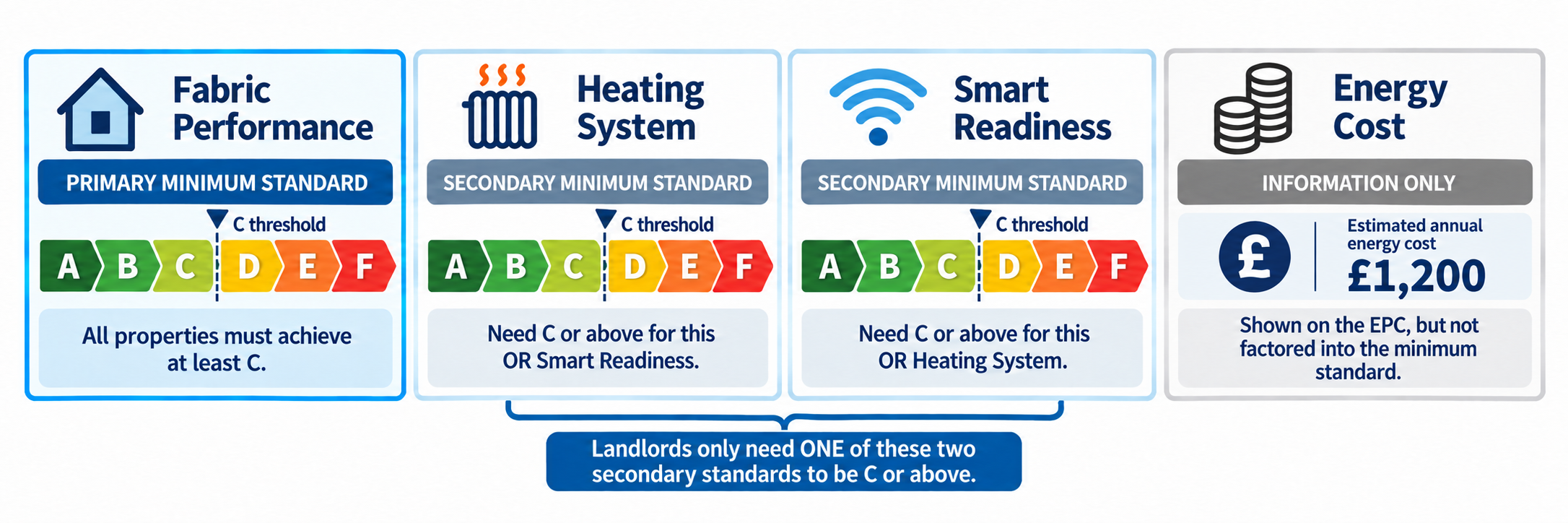
Fabric Performance is the first of these new metrics. It’s the primary minimum standard, meaning every property must be at least a ‘C’ for this, demonstrating that the Government want landlords to take a fabric first approach. So it’s essentially how well a property retains its heat, meaning things like double glazing, loft insulation, wall insulation, so on and so forth, will all come into the rating for this one.
The Government have said they want the boundary between C and D for Fabric Performance to broadly align with the boundary between C and D on today’s overall EPC rating, so if you’re already a ‘C’ now, there’s a good chance you’ll be a ‘C’ for Fabric Performance in the future.
Heating System and Smart Readines
Next we’ve got the two secondary minimum standards: Heating System and Smart Readiness. But landlords will only need to reach a ‘C’ for one of these, NOT both.
Let’s look at Heating System first, which rates what it says on the tin really. Low-carbon systems like heat pumps are likely to score well, but that doesn’t necessarily mean electricity guarantees a good rating, as ordinary direct electric heating is proposed to score a D or below.
We need more information from the Government before we know exactly which systems will – and won’t – reach the minimum standard for this metric, but it’s been widely reported that properties with a gas boiler won’t. So if you’re keeping your gas boiler – either by choice or due to the cost of replacing it – you’ll be targeting the other secondary minimum standard, which is Smart Readiness.
And Smart Readiness is the one confusing most people. In basic terms, it measures how well the property can generate, store and intelligently use electricity, so it’s everything from free or cheaper solutions like smart meters, smart heating controls and even smart EV chargers, to more expensive stuff like solar panels and battery storage. The idea is that a more ‘smart-ready’ property can generate some of its own electricity, store it when there’s plenty available, and use it at cheaper or less demanding times of day.
But as per the running theme here, we don’t yet have the final answer on exactly what gets you a C. So if you’ve got a gas boiler and you’re thinking, ‘Fine, I’ll just target Smart Readiness instead’, I wouldn’t start buying equipment quite yet. We still need the final rules.
(Note: There is actually a fourth headline metric as well: Energy Cost. It’ll be displayed on the EPC like the others, but it isn’t part of the minimum standard landlords have to reach).
The big takeaway
So the big takeaway is that an EPC ‘C’ is about to mean something very different. We know the broad direction: improve the fabric first, then meet either of the Heating System or Smart Readiness standards. But some really important detail is still to come from Government, and that detail could make an enormous difference to what landlords actually need to spend. We’re keeping a very close eye on this for our clients, but if you want my advice on what you could and should do now, take a look at my recent video on this very topic.
Further reading & videos from our team
- What landlords in Wales need to know about the new EPC & MEES rules
- How landlords can stop worriyng about EPC rules until 2036 - without spending a penny on work
- If you have an EPC rated 'D', should you make improvements now or wait?
- Can landlords in Wales remain EPC compliant with a gas boiler?
The information contained within this article was correct at the date of publishing and is not guaranteed to remain correct in the present day.