
EPC / Minimum Energy Efficiency Standards (MEES) update
Insight from our Director of Operations, Nik Lewis. Nik keeps a close eye on the changes affecting landlords across Cardiff and Wales - for more regular updates, advice and opinion, follow @thecardifflettingagent on Instagram.
Short on time?
I've put together this simple two-page guide covering the key changes and what they mean for landlords.
It's not just 2030 landlords need to think about
Most of the talk about Minimum Energy Efficiency Standards (MEES) focuses on 2030, but landlords need to be aware of changes coming much sooner.
New-style EPCs are expected from late 2027, and there's another important deadline in September 2029 that could make a big difference to how landlords achieve compliance.
With more landlords asking me what they should be doing now, I thought it would be useful to explain what's changing, clear up a few misconceptions and share the advice I'm currently giving landlords.
Look beyond the headlines
I keep reading that "properties must be at least an EPC 'C' by 2030", which doesn't paint an accurate picture. A statement like that would have you believe that properties will continue to be rated with a single, overall Energy Efficiency Rating (EER) in 2030, but that won't be the case.
Instead, properties will have multiple headline ratings.
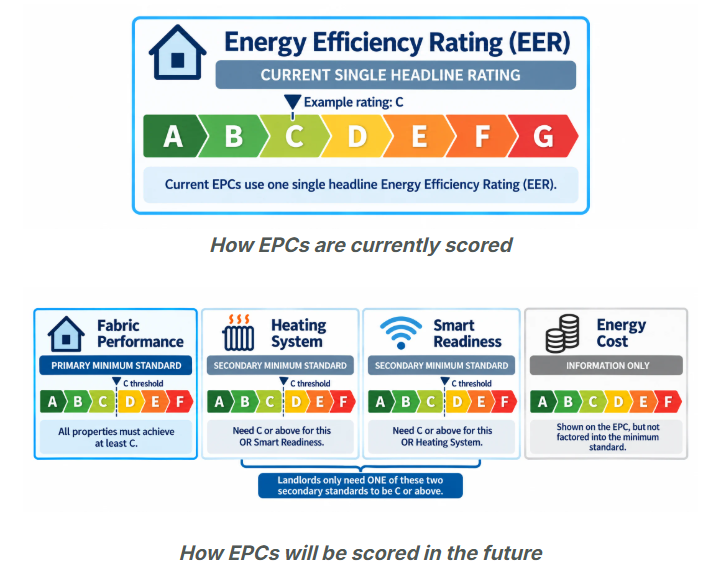
New-style EPCs expected to be available late 2027
The Government say that the new-style EPCs with multiple headline ratings (as shown above) will be launched in late 2027. Once in use, there will be a period where these new-style EPCs display the multiple headline ratings and the current single, overall Energy Efficiency Rating (EER).
Why is 1st October 2029 important?
2030 might be getting all the headlines, but there's another important deadline that landlords should have firmly on their radars.
The Government has confirmed that landlords who obtain an EPC with an EER of 'C' or higher before 1st October 2029 will be treated as compliant with the new 2030 standards until that EPC expires or is replaced.
In other words, 30th September 2029 is the last opportunity to secure up to 10 years of compliance using the existing EER rating, rather than having to meet the new multiple-rating standards.
Properties that haven't achieved an EER 'C' by then will instead need to demonstrate compliance under the new EPC system by 1st October 2030, or qualify for an exemption.
What are the new minimum standards?
Properties will need to achieve at least a ‘C’ for Fabric Performance (the primary minimum standard), plus a ‘C’ for one of (not both) Smart Readiness or Heating System (the secondary minimum standards).
Compliance needs to be in place by 1st October 2030, and is evidenced by the production of a new-style EPC.
Alternatively, the landlord can apply for one of the various exemptions available. Common exemptions include spending up to £10,000 on suitable upgrades and still not reaching the minimum standard, having made all possible upgrades, or having only solid wall insulation as a remaining upgrade. These exemptions are not yet set in stone, though.
Will all of this definitely come into law?
The above information is based on announcements made by the Government, though none of it is yet legislated for.
Due to recent change in Prime Minister and reshuffling of his Cabinet, I have a hunch the compliance dates could get pushed back, but I think the aims and standards will remain the same.
Will certain properties be penalised or rewarded more?
This is getting a little bit technical, but current EPCs are based on the Standard Assessment Procedure (SAP), which is due to be replaced by the Home Energy Model (HEM) when the new-style EPCs come in.
HEM will favour solar panels and heat pumps over gas boilers (but that doesn't mean every property with a gas boiler will fail to meet the new standards). Also, HEM will no longer unfairly penalise all-electric properties in the way SAP does now.
I should also point out that tweaks to the existing SAP have occurred over the years, so there’s never a guarantee that a property will have the same rating today as it did in the past. For example, in June 2025, a significant change was made, meaning assessments now require more detailed inspections and measurements (types of walls, measuring all windows, thickness of roof insulation, type and number of light bulbs, etc – all of which will make a bit of a difference to the rating).
What work should I do now, if anything?
At this stage, I’d only recommend inexpensive, straightforward improvements, starting with fabric-related measures (insulation, double glazing), followed by quick wins such as low-energy lighting, thermostatic radiator valves and room thermostats.
My reasoning is that, under the new standards, all properties will need a ‘C’ for Fabric Performance first and foremost. The Government has suggested aligning Fabric Performance as closely as possible with the current EER, so achieving an EER ‘C’ now could put you in a good position for the future.
However, we don’t yet know exactly what will be required to achieve a ‘C’ for either Heating System or Smart Readiness, and there are strong indications that properties with gas boilers may struggle to achieve a ‘C’ for Heating System. Until we know more, I’d avoid spending significant sums on anything beyond those straightforward improvements.
There’s also the proposed £10,000 cost cap to consider. Heating System and Smart Readiness improvements won’t count towards this until all Fabric Performance improvements have been completed, or the cap has been reached through fabric improvements. Eligible spending since October 2025 counts towards the cap, including the cost of commissioning an EPC, but installing fossil-fuel heating systems does not.
With all that in mind, my current advice to landlords is:
- Already have an EER ‘C’ or higher? You could do what many landlords are doing in this situation and get a new EPC now/soon, hopefully achieve a ‘C’ again, and therefore secure another 10 years of compliance. But remember: there's no guarantee it'll remain the same rating.
- Have a high ‘D’, close to the 69 points needed for a ‘C’? Make some of those inexpensive improvements, then commission a new EPC in the hope of achieving a ‘C’ and securing that same 10-year protection.
- Have a low ‘D’, ‘E’ or ‘F’, where reaching a ‘C’ would be expensive? Hold off on major spending until the Government clarifies the Heating System and Smart Readiness requirements. You can then plan improvements properly and explore any exemptions you might qualify for.
- Already have solar panels or a heat pump? The new Home Energy Model is expected to favour technologies such as solar panels and heat pumps over gas boilers, so your rating may actually improve under the new EPC system. Waiting could therefore work in your favour.
Finally, remember that an EPC is only as accurate as the assessor who produced it. I’ve seen plenty of properties rated lower than they should be simply because the assessor wasn’t attentive enough. Have a watch of my video on this very subject. You could already be sitting on a ‘C’, particularly if you’ve made improvements since your last assessment.
The information contained within this article was correct at the date of publishing and is not guaranteed to remain correct in the present day.