

FAQs for landlords: Upcoming EPC reforms & minimum energy efficiency standards
General EPC changes
What are the upcoming changes to Energy Performance Certificate (EPC) assessments?
The UK Government will revamp how Energy Performance Certificates (EPCs) display energy efficiency, as outlined in their Reforms to the Energy Performance of Buildings Regime consultation.
Instead of a single energy efficiency rating (A-F), EPCs will feature four headline metrics:
- Fabric Performance – Measures insulation and building efficiency.
- Heating System – Assesses heating efficiency and environmental impact.
- Smart Readiness – Evaluates the property’s ability to integrate smart energy technology.
- Energy Cost – Provides an estimated cost of energy use.
These changes aim to provide a clearer and fairer picture of a property’s energy performance.
When will these new-look EPCs be in effect?
The new EPC format is expected to roll out in the second half of 2027.
Why is the EPC system being updated?
The current system is tied to fluctuating energy costs, which can make EPC ratings misleading. The new system aims to provide a more accurate reflection of a property’s energy efficiency, independent of energy price variations.
EPC validity & requirements
Will the validity period of EPCs change?
Currently, EPCs last for 10 years and are only required at the point of build, sale, or a new tenancy. As part of the consultation, the government invited comments on reducing the validity period to ensure energy efficiency is more regularly reviewed.
Will landlords need to renew EPCs for ongoing tenancies?
Under current rules, EPCs are only required when tenants change. However, the government is considering changing it so that landlords must always obtain a new EPC once the current one expires, similar to gas safety certificates.
When marketing a rental property, when must an EPC be provided?
Under proposed reforms, a valid EPC must be available before a property is marketed for sale or rent – eliminating the current 28-day grace period.
Minimum Energy Efficiency Standards from 2030
What are the new minimum energy efficiency standards?
From 2030, properties must be rated at least a 'C' for:
- Fabric performance – this will be mandatory, i.e. the primary requirement.
- Heating system or smart readiness – these two will be mandatory secondary requirements (landlords must meet the minimum standard for at least one).
Will properties with an existing ‘C’ rating need a new EPC when new minimum standards come in?
No. If a property has a valid EPC rated ‘C’ or above when the new minimum standards come in in 2030, it will be considered compliant until the certificate expires.
What happens to properties rated below ‘C’ when the new minimum standards come in?
Landlords will need to obtain a new EPC. If the property does not meet the new standards, improvements will be required in order to comply.
What EPCs might look like and the metrics properties will be targeted on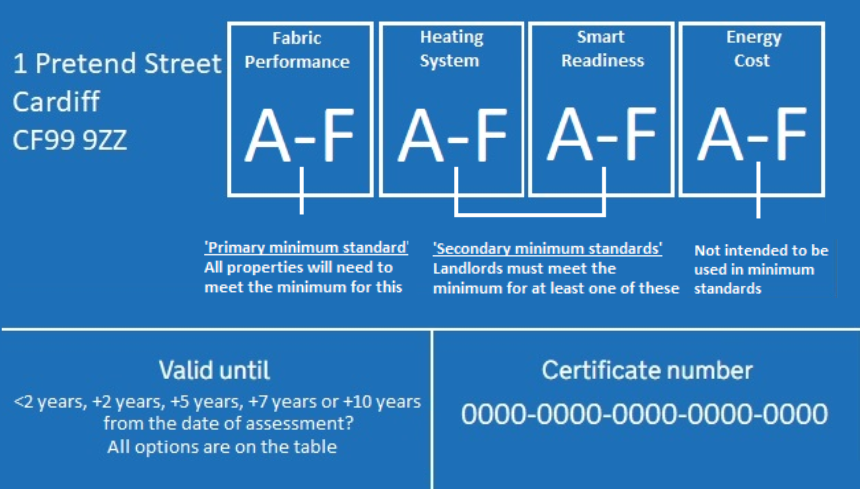
Cost & compliance
If I want to improve energy efficiency in my property now, what would you recommend?
We suggest taking a ‘fabric first’ approach. Focus on enhancing insulation, ventilation, and window fittings. However, before making any upgrades, be sure to check out our ‘expert advice’ section at the bottom of this article.
How much will landlords need to invest to meet the new standards?
The current cost cap to comply with minimum energy efficiency standards is £3,500, but the government is increasing this to £10,000 (including VAT).
Will any energy efficiency investments I make before 2030 be included in the £10,000 cost cap?
Yes, any relevant work completed from October 2025 onwards can be counted towards the cap, including the cost of the new EPC.
How does the cost cap apply if I’ve spent £6,000 on upgrades, but the final recommended improvement is going to cost £10,000 to install a new heating system?
In this scenario, since the final upgrade would exceed the cost cap of £10,000 (£6,000 + £10,000 = £16,000), you wouldn’t be required to proceed with the installation of the new heating system. Instead, you could register a ‘high cost’ exemption.
Will there be other exemptions available for landlords?
Yes. On top of the cost exemption explained above, there are other exemptions such as "I've completed all the improvements recommended on the EPC and it's still not a 'C'", a solid wall insulation exemption, and one for work that would negatively impact the property’s value.
Will there be funding support available?
Yes. Current schemes such as the Boiler Upgrade Scheme, the Great British Insulation Scheme, and the Warm Homes Nest scheme offer financial support. The government plans to introduce further funding options before the new regulations take effect.
What are the penalties for non-compliance?
Currently, landlords face fines of up to £5,000 for non-compliance with minimum energy efficiency standards. The government will be increasing this to £30,000 per property.
Short-term & holiday lets
Will short-term and holiday lets require an EPC?
Yes. The government plans to introduce legislation requiring all short-term/holiday lets to have a valid EPC, regardless of whether the occupier pays the energy costs.
Expert advice for landlords
- If your property is already rated ‘C’ or above, consider getting a new EPC soon to lock in compliance for 10 years.
- If your property is just below ‘C’, consider making small upgrades now to get you up to a ‘C’ now, for the same reason as above. This is especially true for properties with gas central heating, as the new EPC system will penalise because of carbon emissions.
- If your property is significantly below ‘C’, wait until the new EPC system launches before making upgrades.
The information contained within this article was correct at the date of publishing and is not guaranteed to remain correct in the present day.