

How courts assess disrepair, what a ‘thumbs up’ emoji really means, and being a landlord is deemed a business
A recent court case caught my attention and, for three key reasons, I think it’s one every landlord should be aware of.
What was the case about?
This was an English case (N'Guessan & Anor v Bewry [2026]) involving a 2-bed ex-council flat in a purpose-built block from around the 1950s, occupied by a mother, daughter and granddaughter.
Although it was an English decision, there’s nothing in it that wouldn’t be looked at very similarly in Wales.
The landlord had issued a rent increase notice. The tenant didn’t challenge it formally (i.e. at tribunal), but continued paying the old rent, not the increased amount. That led to rent arrears building up, and the landlord took the case to court seeking possession and payment of arrears.
In response, the tenant counterclaimed for disrepair.
So, the judge had to decide two key things:
- Was the rent increase valid, meaning arrears existed?
- Should the tenant receive any compensation for disrepair?
The case ultimately became a detailed breakdown of how courts assess landlord responsibility and tenant compensation.
1. Compensation is based on loss of amenity and expressed as a percentage of the rent
Tenants will often claim that one or two issues mean they’re entitled to stop paying rent altogether. We’ve always known that isn’t how it works, but it’s rare to find a court judgement that goes into the level of detail this judge did, so it’s a useful case study.
The judge looked at when the landlord was notified of each issue, allowed a reasonable period to fix them, then calculated compensation based on loss of amenity after that point.
In the end, the tenant was awarded £8160.66 for the defects.
Here’s how it broke down:
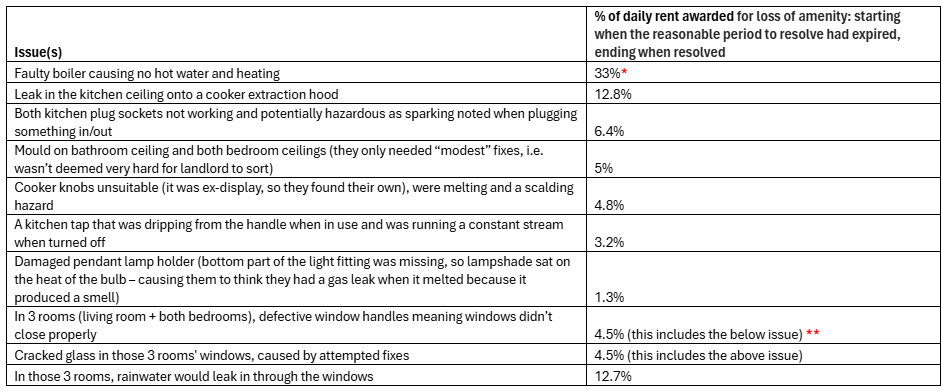
* The judge noted it was the coldest part of the year and over the festive season.
** The handles were deemed complex to repair because the landlord’s contractor had trouble finding replacements that would work. However, the judge did state the level of effort he expected the landlord to go to, saying: “There is no evidence that the landlord made enquiries of the freeholder (the Local Authority, which had a number of other flats which presumably needed the same window handles), to ask what it did, nor of sourcing a specialist window supplier, making internet searches or even commissioning a bespoke reconstruction of the original handles.”
A few key takeaways from this:
- Compensation is granular and evidence-based.
- It only applies after a reasonable period to make fixes has passed – and that period only starts when the landlord is made aware of the issue.
- The more serious the issue (e.g. heating), the higher the percentage of rent awarded.
- Smaller issues still add up significantly over time if left unresolved.
It’s a good reminder that speed matters. Even relatively minor issues become expensive when they drag on.
On the flip side, it also reinforces that tenants can’t simply decide to withhold all rent. The court will break things down much more precisely than that.
I thought the judge’s decision to award compensation for mould on three ceilings was an interesting one. It made me wonder, based on the limited facts, how much consideration was given to tenant behaviour and what we used to know as “tenant-like manner”. We don’t have the full picture, but it’s something landlords should always be mindful of evidencing. "Tenant-like manner" is no more in Wales, but we've got our clients covered.
Notably, the solicitor acting for the tenant didn’t plead that the property was unfit for human habitation, so the judge didn’t look at it under this lens. If they had, the judge’s assessment of general damages would have taken a more overall view of the property’s unfitness, rather than focusing on the individual loss of amenity caused by each defect.
2. A thumbs up emoji is not an agreement 👍
There was also an interesting argument around a WhatsApp exchange.
Upon receiving the rent increase notice, the tenant sent a WhatsApp message to her landlord saying she couldn’t afford the rent increase. The landlord replied saying she had to pay it, and an exchange of further messages followed.
The landlord responded to one of the tenant’s messages saying that she could not afford the increase with a 'thumbs up' (👍) emoji. The tenant argued this meant the landlord had agreed that the rent would no longer go up.
The judge didn’t accept that, saying:
“It could simply mean that he noted her view, or that he understood it. It may be that he agreed that she could not afford to pay the new rent – but that is very different to making the next step to agreeing that the rent would not, therefore, be increased. In my judgment, as a matter of contractual construction the thumbs up emoji did not amount to an agreement to waive the rent increase.”
So, the rent increase notice stood, but the tenant was allowed to deduct the compensation awarded for defects from the arrears.
The key point here is that informal communication can easily be misunderstood or challenged. If something matters, it should be clearly stated. Otherwise, you risk disputes about what was or wasn’t agreed
3. Being a landlord is a business – not a casual arrangement
The court didn’t see this as one individual versus another. It viewed it as a business (the landlord) providing a service to a consumer (the tenant).
The judge said:
“In my view, a landlord who rents out residential property is entering into a business transaction: they have gone into business as a landlord. Doing so is a serious business, with serious obligations. A failure to ensure that a rented home is safe can have fatal consequences. The Government has passed a raft of measures which impose obligations on landlords … Being a landlord can generate income in the form of profit – the pursuit of which is normally the reason people become landlords – but can also involve losses when expenses have to be paid, and for which a landlord must make provision. I was not wholly convinced that the First Claimant [the landlord] had fully grasped the breadth of obligations upon him.”
This means landlords:
- Are expected to understand their obligations
- Need to manage contractors properly, not just instruct them and assume it’s done
- Should budget for repairs and risks, not just rely on rental income
It also ties into something we regularly say: even if you use a letting agent, you remain responsible. The court won’t accept “the agent didn’t do it properly” as a defence.
Why use CPS Homes?
- Our dedicated maintenance portal allows occupiers to easily report issues and upload photos or videos. Our team carefully assesses each situation to determine responsibility, keeping contract-holders in the loop. We may tell the contract-holder that they’re responsible for resolving the problem, offering advice and letting them know we’ve made a note to check it at the next inspection too. It might be the case that we contact the landlord for guidance, or go ahead with instructing a contractor to attend. We tailor our approach to each individual case, ensuring the most effective resolution.
- Our regular inspections are thorough and documented with detailed, time-stamped reports. We don’t just go through the motions; we carefully check the property's condition and look for any maintenance problems, even if the contract-holder hasn’t reported them. By catching potential issues early, we prevent them from becoming bigger problems.
- Maintenance issues aside, we also provide landlords with considered improvement advice to help maximise their rental income.
Got a lettings question on your mind? Send it my way - I reply privately to every message, and I pick one each month to feature here (always anonymously).

Like what you’ve read? Keep up with our latest landlord tips and updates by signing up for our landlord newsletter.
The information contained within this article was correct at the date of publishing and is not guaranteed to remain correct in the present day.